


A mug, a roof tile, a bathroom wall tile, a washbasin: all of them are examples of ceramics. What they share is not a shape or a use but a transformation. A soft material is formed, dried, then heated until it becomes a different one.
What is ceramics?
A ceramic is an object made of clay, shaped and then fired. The word comes from the Greek keramos, potter’s clay, and entered English in its modern meaning around 1850. It covers two worlds: the potter’s studio, part craft and part art, and the advanced, or technical, ceramics developed in the 20th century for properties that ordinary pottery cannot match, such as extreme hardness and resistance to heat and wear. These are made from fine powders of inorganic compounds such as alumina, zirconia and silicon carbide, heated until the grains fuse: the process is called sintering. Their applications include hip and knee replacements, dental implants, cutting tools, electronic components and the heat-shield tiles of the Space Shuttle.
In this V&A film, the ceramicists Kate Malone, a former judge on The Great Pottery Throw Down, and Neil Brownsword tour the museum’s ceramics collection, which runs from Chinese porcelain to contemporary studio work: a fair measure of how much the word covers.
Pottery is only one part of it: the part that makes vessels.
Earth and fire: why heat changes the material
Wet clay holds whatever shape you give it. Dried, it hardens, but a dry pot dropped into a bucket of water slumps back into mud. Heat drives off the water chemically bound in its crystals, and that chemical change cannot be undone: the pot has become a kind of artificial stone. At higher temperatures, some components of the body, silica and fluxes, melt and fill the pores. This is vitrification.
The properties of ceramics come from this process: they are hard, strong under compression and resistant to heat, wear and corrosion, with low electrical and thermal conductivity. The downside is familiar to anyone who has dropped a bowl: a ceramic does not bend, it breaks. It is brittle, and thermal shock, a sudden change of temperature, can crack it. The raw materials are common elements of the earth’s crust: clay minerals, quartz and feldspar.
Three clays, three temperatures
Traditional ceramics all start from clay, but not the same one. Terracotta, used for roof tiles, bricks and flowerpots, is the oldest and the most basic: rough, unglazed and absorbent. In the studio, three families do almost everything, and the temperature at which each one matures sets them apart.
- Earthenware fires between 980 and 1050 °C and stays porous: unglazed or chipped, it soaks up liquids. In return, it takes bright decorative colours that higher temperatures would burn out.
- Stoneware typically fires between 1240 and 1280 °C and vitrifies: the pot comes out strong and watertight, even unglazed. Much everyday tableware is made of it, and so is most studio work.
- Porcelain fires between 1200 and 1400 °C depending on the recipe. Made mostly of kaolin, it turns translucent when thin, but it shrinks by 12 to 15 % and warps at the slightest error, which makes it the least forgiving material to work with.
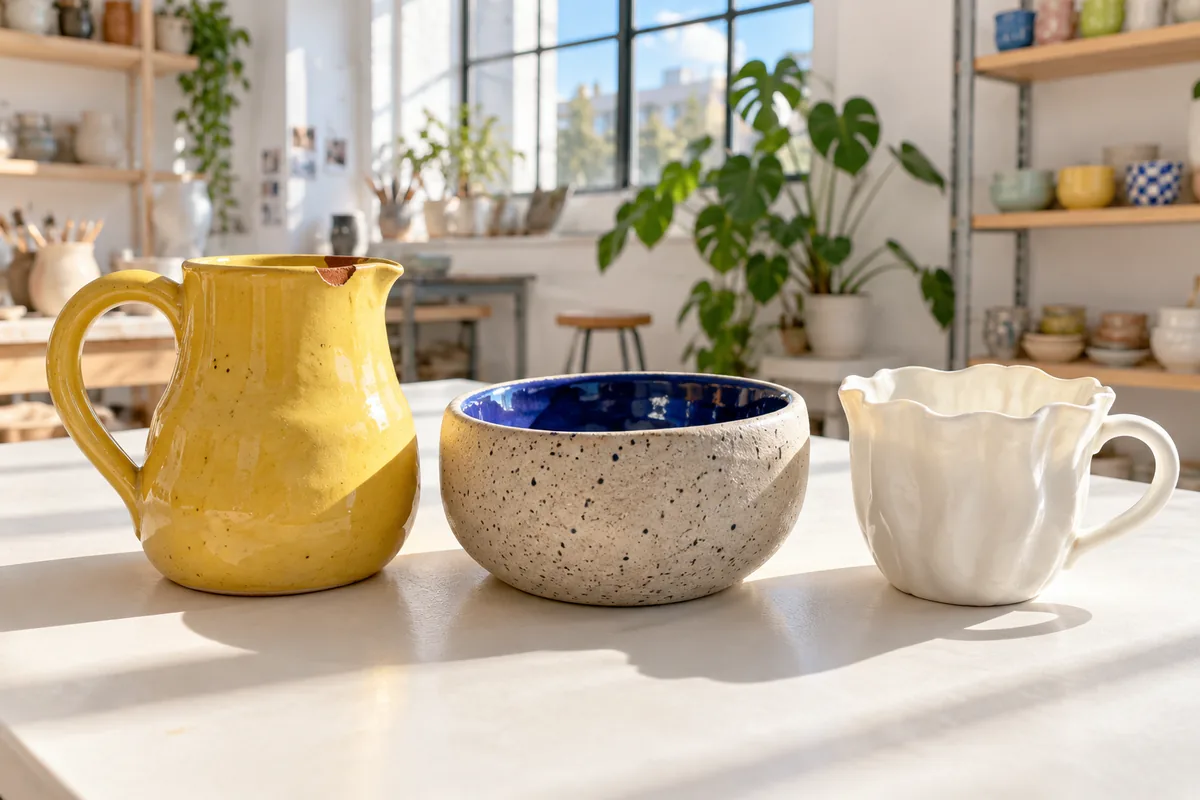
The dividing line matters more than the figures: porous bodies on one side, vitrified bodies on the other. It decides what a pot can be used for, which kiln you need and which bag to buy first.
Clay & formingChoose your clay
Which clay family should you explore for your project and firing?Open / close the tool
Guide your choice according to the available firing, technique and intended use of the piece.
All toolsEnter your parameters to prepare your result.
Understand the calculation
The tool first applies the firing and use constraints, then suggests a clay family to explore. It does not assign an artificial score that can offset an incompatible firing temperature.
This is editorial guidance: the specific product’s data sheet, tests and studio conditions determine the final choice. No average shrinkage or food-use suitability is automatically inferred from a clay family.
References
Shaping techniques
Four techniques cover almost everything. Pinching hollows out a ball between thumb and fingers. Coiling builds a wall from rolls stacked and smoothed together. Slab building rolls out a flat sheet, then cuts and joins it like a paper pattern. Throwing forms the pot on a spinning wheel head once you have learnt to centre the clay, which takes several sessions.
The first three are hand-building techniques and give results from the very first class. Industry and many studios also cast slip, a liquid clay, in plaster moulds to make identical items. Learn on a wheel before you buy one; when the day comes, choosing your first pottery wheel explains what matters.
Drying and the two firings
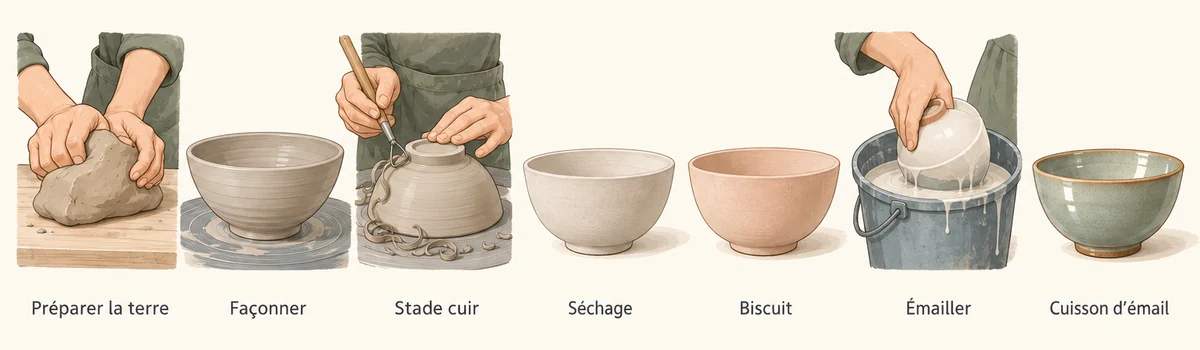
A freshly made pot has to dry slowly and evenly. If the rim dries faster than the base, the difference in shrinkage cracks the piece. It must also be dry right through, or the steam will blow it apart as it fires.
The first firing, the biscuit (or bisque), takes stoneware and porcelain to 900–1000 °C. Earthenware is often biscuited higher, around 1000 to 1050 °C, because many potters mature the body in that first firing and fire it lower the second time. The pot comes out solid but still absorbent, ready to be glazed. The second and final firing follows, at the temperature the glaze and the clay require; this is where stoneware and porcelain vitrify.
A kiln that reaches 1280 °C costs several thousand pounds. In the UK, many home models up to about 60 litres draw 13 amps or less and come with an ordinary plug, but the socket must be on a circuit that can carry that load for a whole firing; anything above 3 kW needs a dedicated circuit fitted by an electrician. Either way it needs a ventilated room that nobody lives in, because glazes give off fumes as they mature. Buying one is covered in choosing a home model; until then, fire your pieces in a studio kiln open to hobby potters.
Glaze and decoration
A glaze is a thin layer of glass melted onto the surface. Ground minerals form its base and metal oxides give the colour: cobalt gives blue, copper green or red, and iron gives amber, browns and blacks or, in a reduction firing, the pale green of celadons. Applied to the biscuit by dipping or brushing, it looks dull and chalky until it melts.
Pots are also decorated with coloured slip, brushed onto the unfired piece, or by carving into the surface. One rule never changes: only a suitable ceramic glaze, fired to its correct temperature, makes a pot safe for food and drink, because some glazes contain lead, barium or cobalt. The “ceramic paints” sold in craft shops are not glazes; their limits are explained in painting on ceramics.
A short history
Ceramics is the oldest of the fire arts: human beings fired clay long before they melted glass or metal. Among the oldest ceramic objects known are figurines, not vessels, such as the Venus of Dolní Věstonice, from what is now the Czech Republic, made in the Gravettian period, around 30,000 years ago.
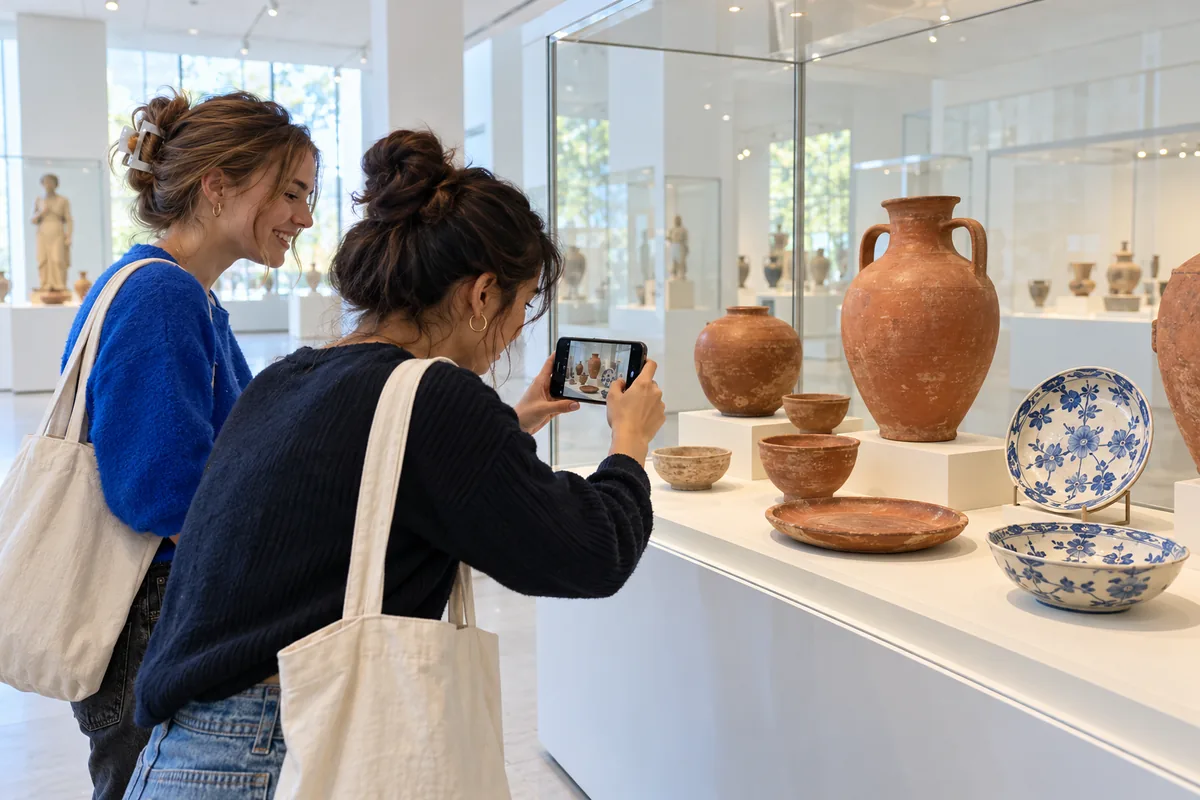
The oldest known pottery comes from Xianren Cave in China: a study published in Science in 2012 dates it to about 20,000 years ago. In Britain and Ireland, pottery arrived with the first farmers, around 4000 BC. Their plain bowls with a sharp shoulder, the Carinated Bowls, follow a style from northern France; the hunter-gatherers before them had never made pots.
Tin-glazed pottery appeared in what is now Iraq in the 9th century. The French call it faience, after the Italian town of Faenza; in Britain it became delftware, made in London, Bristol and Liverpool. Porcelain is Chinese, but when it was born depends on the definition: the first true porcelain is usually dated to the Eastern Han, and the technique had matured by the Tang dynasty, somewhere between about AD 200 and 800. Europe first imitated it with soft paste, made without kaolin, until Meissen, in Saxony, began making hard paste in 1710. In England, Chelsea and Bow made soft paste from the 1740s, William Cookworthy patented hard paste made with Cornish china clay in 1768, and by 1800 Spode, in Stoke-on-Trent, was selling bone china. Half of its body is calcined bone, traditionally from cattle, and it is prized for its strength and whiteness.
Careers in ceramics
Ceramicist is the word that covers everyone: the studio potter, the porcelain maker, the tile maker, the brickmaker. Factories employ throwers, mould makers and decorators; the advanced ceramics industry employs engineers who develop new ceramic materials and their applications. In the UK, the usual routes in are a college art and design course, a foundation degree or degree in ceramics or 3D design, a Craft Technician apprenticeship, or years as a studio assistant.
Many independent potters combine selling their work, at craft fairs, potters’ markets and galleries, with teaching, which pays more steadily. Selling regularly makes you a trader in HMRC’s eyes: once your sales pass £1,000 in a tax year (6 April to 5 April), you must register as a sole trader for Self Assessment. If you already teach, you can list your studio on Ceramispot.
Where to start
With a session in a studio, before buying anything: trying ceramics for a single session is enough to feel whether you prefer the wheel or hand-building. Make your first pieces in stoneware, which forgives clumsy hands. Choosing a pottery class then helps you decide between a weekly course, a one-day workshop and open studio time.
At home you can shape clay, but what has never been fired is not ceramics. Air-dry clay hardens as it dries and never becomes watertight, so it is never for mugs, plates or bowls you eat or drink from. The fine dust from your work contains crystalline silica, which causes silicosis, a lung disease that cannot be reversed: clean with a wet sponge or a Class M vacuum, never a broom, and wear an FFP3 mask for sanding.
Frequently asked questions
What is ceramics in simple terms?
Ceramics means objects made from clay and then hardened by heat, and by extension the material and the craft. The change is permanent: once heated, a pot never turns back into mud. The word comes from the Greek keramos, potter’s clay. In its wider meaning it covers everything from terracotta flowerpots to the advanced ceramics used in engineering.
What are the three types of ceramics?
In pottery, the three types are earthenware, which fires at around 980 to 1050 °C and stays porous, stoneware (1240 to 1280 °C) and porcelain (1200 to 1400 °C), which both vitrify and become watertight. Materials scientists split ceramic materials differently: traditional clay-based ceramics on one side, advanced ceramics such as alumina or silicon carbide on the other.
Is ceramic waterproof?
It depends on the material. Terracotta and other low-fired bodies stay porous: water soaks in wherever they are left unglazed. Stoneware and porcelain vitrify at high temperature and become watertight right through. For tableware, the glaze must also be suitable for food and taken to its correct temperature.
Is ceramics the same as pottery?
No. Pottery is the part of ceramics that makes vessels: bowls, jugs, mugs, dishes and vases. Ceramics also covers decorative tiles, bricks, washbasins, sculpture and the advanced ceramics used in medicine, electronics and aerospace. Every pot is a ceramic, but most ceramics are not pots.
What is the oldest ceramic in the world?
The oldest ceramic objects known are Gravettian figurines such as the Venus of Dolní Věstonice, in the Czech Republic, made around 30,000 years ago. The oldest known vessels, from Xianren Cave in China, are about 20,000 years old. In Britain, pottery appears shortly before 4000 BC, with the first farmers.
Sources
- Wikipedia, “Ceramic” — etymology from the Greek keramikos and keramos, potter’s clay; advanced ceramics such as silicon carbide and tungsten carbide (accessed October 2026)
- Merriam-Webster, “Ceramics” — first known use of “ceramic” in English in 1850 (accessed October 2026)
- Science Learning Hub (University of Waikato), “What are ceramics?” — traditional and advanced ceramics, alumina and zirconia in dental implants and hip and knee replacements, ceramic tiles of the Space Shuttle (accessed October 2026)
- BBC Bitesize, “What are ceramics?” — properties of ceramics, brittleness, heat resistance, ceramic tiles on reusable spacecraft (accessed October 2026)
- Wikipedia, “Kate Malone” — judge on BBC Two’s The Great Pottery Throw Down from 2015 to 2017 (accessed October 2026)
- Victoria and Albert Museum, “Highlights from the Ceramics collection” — the film with Kate Malone, Neil Brownsword and curators Reino Liefkes and Alun Graves (accessed October 2026)
- Victoria and Albert Museum, Ceramics — collections from about 2500 BC to the present day, from Chinese porcelain to contemporary studio ceramics (accessed October 2026)
- Potclays, “What is the ideal bisque firing temperature?” — stoneware and porcelain biscuit fired to about 1000 °C, earthenware matured in either the biscuit or the glaze firing (accessed October 2026)
- Wikipedia, “Biscuit (pottery)” — biscuit firing usually at least 1000 °C, porous biscuit earthenware, non-porous vitreous wares (accessed October 2026)
- Kiln Crafts, “Pottery kilns for home” — 30 to 61 litre kilns on a 13-amp plug reaching 1300 °C, from £2,618 to £4,095; the socket must be on a circuit that can take the load; dedicated circuit above 13 A (accessed October 2026)
- Kilncare, “Having a home kiln: things to consider” — a 230 V kiln above 3 kW / 13 A cannot be plugged into a wall socket; ventilation essential (accessed October 2026)
- Ceramics Monthly, “Techno File: Iron in Celadons” — iron gives pale yellow to amber in oxidation, celadon greens and blues in reduction (accessed October 2026)
- Digitalfire, “FeO” — iron in reduction, celadons, browns and tenmoku blacks (accessed October 2026)
- Wikipedia, “Venus of Dolní Věstonice” — ceramic figurine of the Gravettian, dated 31,000 to 27,000 years ago (accessed October 2026)
- Wikipedia, “Xianren Cave” — pottery dated to 20,000–19,000 years before present, Science 2012 (accessed October 2026)
- Wikipedia, “British Neolithic pottery” — earliest pots in Britain shortly before 4000 BC, Carinated Bowl style linked to farmers from the continent (accessed October 2026)
- ScARF, “Early Neolithic pottery” — Carinated Bowl introduced from northern France by farmers arriving around 4200 to 3800 BC; pottery unknown before in Britain and Ireland (accessed October 2026)
- Wikipedia, “Tin-glazed pottery” — first made in Iraq in the 9th century; English delftware; faience in France (accessed October 2026)
- Wikipedia, “Faience” — the name is the French name for Faenza (accessed October 2026)
- Victoria and Albert Museum, Bristol delftware plate (O21297) — tin-glazed earthenware made in Bristol, London and Liverpool (accessed October 2026)
- Wikipedia, “Porcelain” — porcelain matured in China between about 200 and 800 CE depending on the definition; soft-paste porcelains; Meissen (accessed October 2026)
- UNESCO Silk Roads, “Chinese Porcelain” — first true porcelain under the Eastern Han, techniques matured under the Tang (accessed October 2026)
- Science Museum, “Perfecting porcelain” — Meissen hard paste in 1710, English soft paste from 1742 then Chelsea and Bow, Cookworthy’s 1768 patent and Plymouth factory (accessed October 2026)
- Spode, “Development of Bone China” — Cookworthy’s 1768 patent for china clay and china stone; Spode bone china marketed by 1800, 50 % calcined bone (accessed October 2026)
- Wikipedia, “Bone china” — developed by Josiah Spode in Stoke-on-Trent in the 1790s; about 50 % bone ash, traditionally from cattle bones; among the strongest and whitest whitewares (accessed October 2026)
- National Careers Service, “Ceramics designer maker” — routes through university, college, Craft Technician apprenticeship and studio work (accessed October 2026)
- Cardiff Metropolitan University, BA (Hons) Ceramics — content of a UK ceramics degree (accessed October 2026)
- GOV.UK, “Set up as a sole trader” — register for Self Assessment if you earn more than £1,000 in a tax year (accessed October 2026)
- GOV.UK, “Tax-free allowances on property and trading income” — £1,000 trading allowance (accessed October 2026)
- HSE, “Silicosis” — respirable crystalline silica in clays, lung fibrosis after long exposure (accessed October 2026)
- HSE, “COSHH essentials in ceramics: Silica” (CR1) — vacuum dry dust or use wet cleaning methods, Class M vacuum; silicosis is irreversible (accessed October 2026)
- Health and Safety Authority (Ireland), “Crystalline silica dust” information sheet — pottery and ceramics listed among exposed trades, wet methods, FFP3 or P3 respirator (accessed October 2026)


